
Methodology
Community health services are complex, distributed and data-rich - but often lack a consistent, system-wide view of performance.
Benson Health provides a structured methodology to bring together fragmented operational data, standardise it into a consistent model, and generate actionable insight across workforce, activity, demand and outcomes.
Our approach combines robust data engineering, a standardised community health framework, and practical service modelling - enabling providers to move from retrospective reporting to proactive service planning and transformation.
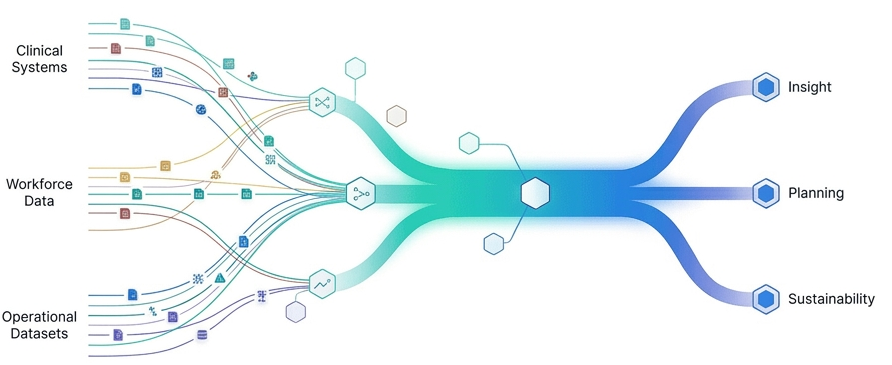
1. Data Integration & Standardisation
We begin by connecting to existing provider systems - including clinical systems (EPR), workforce data (ESR), rostering tools and local datasets.
Data is extracted, validated and transformed into a consistent, structured model aligned to a standard set of community health metrics. This removes variation in definitions, improves comparability, and ensures a single version of the truth across services.
The result is a unified dataset that reflects how services actually operate - across teams, disciplines and care settings.
2. Operational Insight & Benchmarking
Once data is standardised, Benson generates a comprehensive suite of pre-built reports covering key domains:
- Workforce productivity and clinical capacity
- Demand, referrals and caseload complexity
- Clinical activity and delivery models
- Workforce utilisation and skill mix
- Service performance and variation
These insights are available at all levels - from organisation to team and individual staff groups - and can be shared securely across services.
Providers can benchmark performance internally and, where appropriate, externally, identifying variation, inefficiency and areas of opportunity.
3. Workforce & Capacity Modelling
Benson moves beyond reporting to support evidence-based workforce planning.
Using historic activity, demand trends and workforce data, we model:
- Clinical capacity and available workforce
- Impact of travel, admin and non-clinical time
- Caseload complexity and intensity
- Allocation of work across roles and bands
This enables providers to understand whether current workforce models are sustainable, and where changes in structure, allocation or staffing are required.
4. Demand Forecasting & Scenario Planning
Understanding future demand is critical for service sustainability.
Benson incorporates demand profiling and forecasting to model how services will evolve over the next 12–24 months, based on:
- Referral trends and growth rates
- Changes in population and need
- Service configuration and pathways
Providers can test different scenarios - including workforce changes, productivity improvements or service redesign - to understand cost, capacity and performance implications.
5. Service Transformation & Sustainability
Insights and modelling are translated into practical, implementable change.
Benson supports providers to:
- Identify and quantify productivity opportunities
- Standardise clinical roles and delivery models
- Optimise workforce deployment
- Align capacity to demand
- Develop sustainable service configurations
This ensures that transformation is evidence-based, measurable, and aligned to operational reality.
6. Embedded Delivery & Continuous Improvement
Benson is not a one-off analysis. It is a live, embedded system.
The platform is deployed within provider environments, enabling teams to:
- Access and share reports in real time
- Monitor performance continuously
- Track the impact of change over time
- Adapt and refine models as services evolve
This creates an ongoing capability within organisations - reducing reliance on external analysis and supporting long-term improvement.